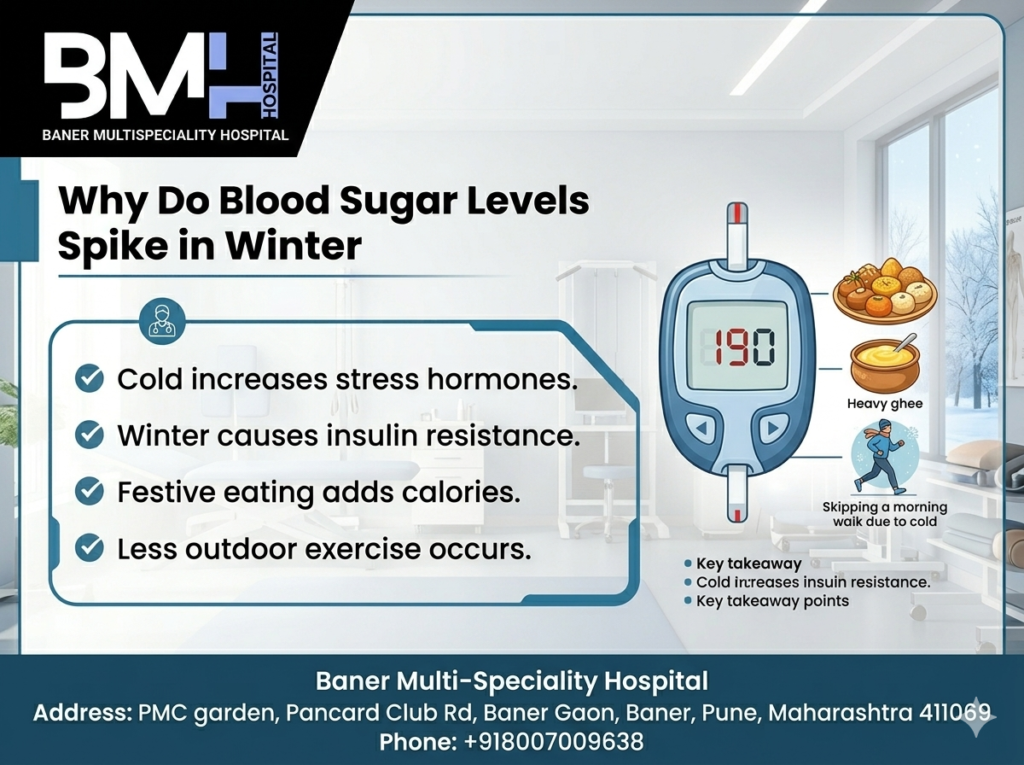
Blood sugar spike in winter is one of the most common yet under-discussed challenges for people managing diabetes in Baner, Pune. Yes, the cold months genuinely change how your body handles glucose — and if you are not prepared, your HbA1c numbers can quietly climb.
This blog is medically reviewed by Dr Venayack Apte, MBBS, MD (Medicine), a diabetologist and physician at Baner Multi-Speciality Hospital with over 10 years of clinical experience. The information here draws from ICMR guidelines, WHO data and peer-reviewed Indian medical research. Whether you live in Baner, Aundh, Pashan or the surrounding Pune IT corridors, the practical tips ahead will help you stay in control through every cool morning.
| Quick Facts • Prevalence: India has 101 million people with diabetes — the world’s second-highest burden (ICMR 2023) • Winter glucose rise: HbA1c averages 0.3-0.5% higher in winter vs summer (Industry estimate) • Festive calorie impact: Extra 400-600 kcal/day during Diwali and winter wedding season (Industry estimate) • Consultation cost in Baner: INR 500 to INR 1,200 per OPD visit (BMH estimate) • HbA1c test cost in Pune: INR 350 to INR 700 per test • Recommended check-up frequency: Every 3 months for controlled diabetes; every 6 weeks if adjusting medication |
Pune Diabetes and Winter Blood Sugar Statistics 2025-2026
| Metric | Data Point | Source |
| Diabetic population in Pune district | Approx 11-13 lakh adults | ICMR 2023 / Industry estimate |
| Rise in diabetes OPD visits Nov-Jan | 15-20% increase at urban clinics | Industry estimate |
| Average HbA1c increase in winter | 0.3-0.5% above summer baseline | Industry estimate |
| Drop in physical activity in winter | 30-40% reduction in steps/day | Industry estimate |
| Extra festive-season daily calorie intake | INR 400-600 kcal above daily requirement | Industry estimate |
| Blood glucose monitoring device cost | INR 800 to INR 3,500 (glucometer) | Market survey 2024 |
| HbA1c test cost in Pune | INR 350 to INR 700 per test | Pathology lab survey Pune 2024 |
| Diabetology OPD consultation Baner | INR 500 to INR 1,200 per visit | BMH clinic estimate |
What Causes Blood Sugar to Spike in Winter? The Science Behind It
The cold does more than make you reach for a shawl. When temperatures fall — even Pune’s mild 12-15 degrees Celsius winters — your body triggers a stress response. Cortisol and adrenaline release rises. These hormones are designed to keep you warm, but they also tell your liver to release stored glucose into your bloodstream.
At the same time, cold weather makes your muscle cells less responsive to insulin. Think of it like a lock getting stiff in the cold: insulin is the key, but the lock (your cell receptors) doesn’t turn as smoothly. This is called cold-weather insulin resistance.
The Dawn Phenomenon in Winter
The dawn phenomenon occurs when blood sugar rises in the early morning hours, typically between 4 AM and 8 AM, as your body releases hormones to prepare for waking up. In winter, this effect is more pronounced. If you check your fasting glucose in January and find it higher than usual, the dawn phenomenon combined with cold-induced insulin resistance is likely the cause.
Does this mean you need more medication in winter? Not always. But it does mean a visit to your diabetologist in Baner is wise before the season shifts.
How Lifestyle Changes in Winter Raise Blood Sugar in Baner
Pune winters are pleasant by national standards, but they still change behaviour in ways that directly affect blood sugar. Here is what typically happens to patients in Baner between November and February.
| Lifestyle Factor | What Changes | Effect on Blood Sugar |
| Less outdoor exercise | Fewer morning walks, less cycling | Direct glucose rise |
| Heavier comfort food | More ghee, sweets, fried snacks | Carb and fat overload |
| Festive eating — Diwali etc. | Mithai, farsan, late-night dinners | Acute glucose spikes |
| Wedding season meals | Multiple high-carb meals at functions | Erratic glucose patterns |
| Reduced water intake | Less thirst in cold — dehydration concentrates sugar | Hidden glucose rise |
| Irregular meal timings | Late mornings, skipped breakfasts | Dawn phenomenon worsens |
| More screen/sedentary time | Work-from-home in IT sector Baner | Lower insulin sensitivity |
Many IT professionals in Baner already lead largely desk-bound lives. When cooler mornings mean skipping the usual walk to Pashan Lake or Baner Hills, that small daily activity loss compounds over weeks into visible HbA1c drift.
Symptoms That Tell You Your Blood Sugar Spiked in Winter
Sometimes a blood sugar spike in winter is silent — you feel nothing unusual. Other times, the signs are clear. Watch for these:
- Frequent urination, especially at night (nocturia)
- Increased thirst despite cooler temperatures
- Feeling unusually tired or sluggish in the morning
- Blurred vision after meals
- Headaches in the morning that ease by mid-day
- Slow-healing cuts or dry, itchy skin in winter
- Numbness or tingling in feet — a warning sign not to ignore
A patient in their 40s from Baner — a software project manager — came to BMH in December complaining only of unusual morning fatigue. Routine testing revealed fasting glucose of 187 mg/dL. He had no other symptoms. Winter had quietly undone three months of good control. A medication review and a structured winter meal plan brought him back to target within six weeks.
Diabetologist in Baner: When Should You Consult One in Winter?
You should not wait for dramatic symptoms to see a diabetologist in Baner. Schedule a winter review appointment if any of these apply:
- Your last HbA1c was between 7% and 8% — borderline control
- You have changed your eating routine because of festive functions or weddings
- You are on insulin and notice erratic morning readings
- You feel less motivated to exercise in cooler weather
- You have a health check-up, job change or interview coming up and want readings optimised
- You are planning Diwali travel or attending multiple functions in December
Dr Venayack Apte at Baner Multi-Speciality Hospital conducts thorough diabetology consultations that include medication review, personalised winter diet counselling and HbA1c target setting. Appointments are available at BMH located in Baner, Pune.
You can visit the diabetology department page at banerhospital.com/diabetology to learn more or book an appointment directly.
Winter Diabetes Management: Comparing Your Options
There is no single approach to managing blood sugar spike in winter. Your diabetologist will tailor a plan based on your type of diabetes, current medication and lifestyle. The table below compares common approaches.
| Approach | What It Involves | Benefit | Consideration |
| Diet adjustments | Reducing simple carbs, adding fibre, controlling portions at festive meals | Highly effective; zero side effects | Requires daily discipline |
| Exercise modification | Indoor yoga, home workouts, stairclimbing to replace outdoor walks | Maintains insulin sensitivity | Needs routine building |
| Medication dose adjustment | Temporary increase in oral medication or basal insulin under doctor guidance | Directly corrects winter rise | Must be doctor-supervised only |
| CGM/glucometer monitoring | More frequent home checks, especially fasting and post-meal | Catches spikes early before damage | Cost: INR 800-3,500 for device |
| Structured OPD review | Quarterly HbA1c, kidney and lipid tests at BMH | Prevents complications | INR 500-700 for tests; visit fee extra |
Winter Diabetes Diet Tips Recommended by BMH Diabetologists
What should you eat differently in winter to prevent a blood sugar spike? The BMH diabetology team recommends practical adjustments that fit Indian family kitchens.
Foods to Prefer in Winter
- Methi (fenugreek) in parathas, vegetables or dal — shown to reduce post-meal glucose in Indian studies
- Ragi (finger millet) rotis over wheat for lower glycaemic impact
- Warm soups with seasonal vegetables: palak, carrots, beans
- Flaxseed added to yogurt or salads — good for glycaemic control and heart health
- Green tea or cinnamon-infused warm water instead of sugary chai
Foods to Limit
- Mithai (ladoos, barfi) even during festive visits — one piece is fine; a plateful is not
- Fried snacks like chakli, sev and chivda at Diwali gatherings
- White rice in large portions at wedding functions
- Alcohol — even one drink can mask hypoglycaemia symptoms in winter
- Full-fat dairy in excess, especially ghee-heavy winter halwas
What about the popular Indian belief that you can eat more in winter because the body burns more? For people without diabetes, there is a small truth to increased metabolic rate in cold. For diabetics, that logic does not hold. Caloric surplus in winter still raises blood sugar, regardless of the season.
Staying Active in Winter to Control Blood Sugar Levels
Exercise is insulin’s best friend. A 30-minute walk lowers blood sugar by 20-40 mg/dL on average, depending on the individual. But Pune’s cool, foggy mornings in December and January make outdoor exercise unappealing for many. Here is what works:
| Activity | Duration | Frequency | Benefit for Blood Sugar |
| Indoor yoga | 30 min / day | 5 days/week | Improves flexibility and lowers fasting glucose |
| Home resistance work | 20-30 min / day | 3-4 days/week | Builds muscle mass; improves insulin uptake |
| Stair climbing | 10-15 min | Daily | Easy in apartment buildings; highly effective |
| Morning stretches | 10 min | Daily | Reduces dawn phenomenon effect |
| Light walk post-meal | 15-20 min | After lunch/dinner | Best single habit for post-meal glucose control |
According to WHO physical activity guidelines, adults with diabetes should aim for at least 150 minutes of moderate-intensity activity per week. Even in winter, that target is achievable indoors.
How to Monitor Blood Sugar at Home in Winter
Home monitoring is not optional in winter — it is a safety net. Here is a simple winter monitoring schedule recommended by BMH:
- Fasting glucose: every morning before breakfast, ideally at the same time
- Post-meal glucose: 2 hours after your largest meal of the day
- Before bedtime: especially if you adjusted medication or ate unusually
- After exercise: to understand how your chosen winter activity affects your levels
- During illness: fever and infections — common in winter — can spike glucose significantly
Under the Ayushman Bharat scheme, eligible patients can access diabetes monitoring and consultations at empanelled hospitals. Check with BMH reception to confirm your eligibility and which services are covered under CGHS or your employer’s TPA scheme.
Managing Winter Blood Sugar in Baner and Pune: Local Factors
Baner sits at the edge of the Western Ghats and experiences noticeably cool, dry mornings from mid-November through February. Temperatures regularly drop to 10-13 degrees Celsius overnight. For the large IT workforce in Baner, Aundh, Pashan and Wakad, this means more indoor sedentary hours during an already desk-heavy workday.
The festive calendar intensifies the challenge. Diwali sweets, followed by a string of winter weddings, then New Year celebrations — each event brings high-carb meals, irregular timings and reduced sleep. Many patients from Baner and Kothrud attend four to six such functions per month between October and January.
Pollution levels in Pune also rise slightly in winter due to crop burning in neighbouring districts and reduced wind dispersal. Research published in the Indian Journal of Medical Research links short-term air pollution exposure to transient rises in fasting blood glucose. It is a small but real additional factor for patients with diabetes.
Baner Multi-Speciality Hospital (BMH) at banerhospital.com is conveniently accessible from Baner, Balewadi, Sus Road, Mahalunge and the Hinjewadi IT Park belt. The diabetology OPD under Dr Venayack Apte operates on weekdays with Saturday slots available for working professionals. Walk-in and online consultations are both accepted.
Winter Diabetes Care Costs in Pune: A Comparison
| Service / Product | Cost Range | Note |
| OPD consultation (general physician) | INR 300-600 | BMH and similar Pune clinics |
| OPD consultation (diabetologist BMH) | INR 500-1,200 | BMH estimate |
| HbA1c blood test | INR 350-700 | Pune pathology labs |
| Full diabetes panel (HbA1c+KFT+LFT+lipids) | INR 1,500-3,500 | Pune diagnostic centres |
| Glucometer device | INR 800-3,500 | Retail/online market 2024 |
| Test strips (50-strip pack) | INR 450-900 | Brand-dependent |
| Continuous Glucose Monitor (CGM) | INR 3,000-6,000 per sensor (14-day) | Market 2024 |
| Insulin pen (month’s supply) | INR 800-2,500 | Brand and dosage-dependent |
Conclusion
Blood sugar spike in winter is predictable — and because it is predictable, it is preventable. Cold-weather insulin resistance, reduced physical activity, festive eating and the dawn phenomenon all converge between November and February to push glucose levels higher for patients in Baner and across Pune.
The good news is that targeted steps — a winter diet plan, indoor exercise, more frequent home glucose checks and a seasonal medication review — can keep your HbA1c on track. Do not assume last summer’s stable readings will hold through a Pune winter without any adjustment.
If you are a diabetes patient in Baner, Aundh, Pashan, Balewadi or Hinjewadi, a pre-winter consultation with a diabetologist is one of the most proactive steps you can take for your health. Book an appointment with Dr Venayack Apte at Baner Multi-Speciality Hospital by visiting banerhospital.com/diabetology. His decade-long expertise in diabetology and internal medicine, combined with a personalised approach, ensures you receive care that is accurate, practical and genuinely suited to your lifestyle.
