| KEY TAKEAWAYS India has the world’s largest burden of hypothyroidism — affecting approximately 42 million people (ICMR 2023). Women are 5-10 times more likely to develop thyroid disorders than men. Iodine deficiency, autoimmune triggers and chronic stress all contribute to the thyroid epidemic in urban Pune. TSH is the single most sensitive screening test for thyroid disorders — normal range is 0.5 to 5.0 mIU/L. Dr Yash Khanwilkar, Dr Vivek Shejole and Dr Satish Chavan manage thyroid disorders at Baner hospital. Uncontrolled hypothyroidism during pregnancy causes fetal brain development issues. Thyroid function test (TFT) in Pune costs INR 400 to INR 900 at Baner hospital’s 24×7 laboratory. |
Introduction
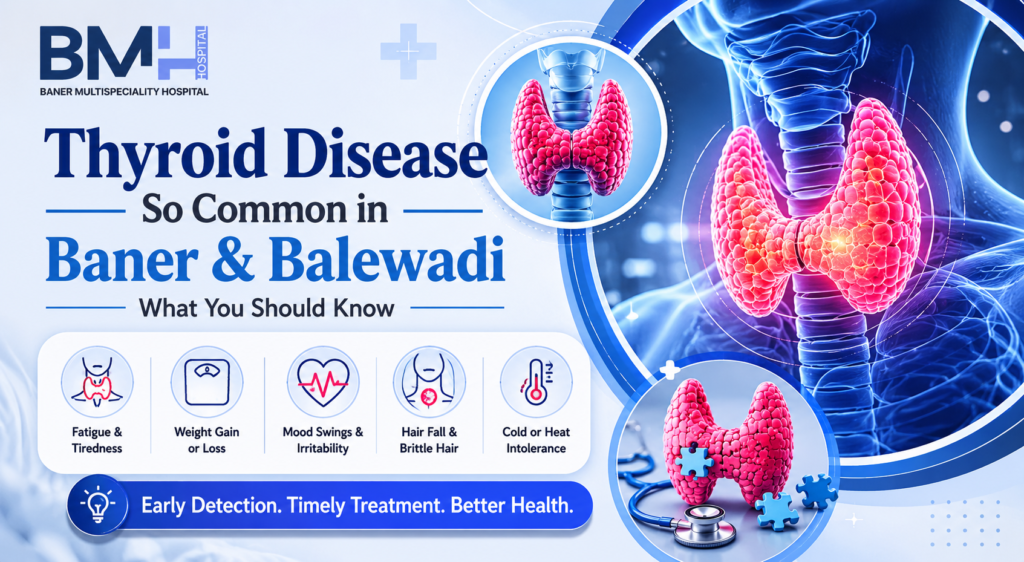
Thyroid disease is one of the most commonly missed conditions in Baner and Balewadi’s working population. The symptoms — fatigue, weight gain, hair fall, mood changes and cold intolerance — are easily attributed to stress and long work hours. By the time the diagnosis is made, patients have often been symptomatic for months or years.
India has approximately 42 million people with thyroid disorders per ICMR data. Pune’s physician team at Baner Multi-Speciality Hospital, including Dr Yash Khanwilkar, Dr Vivek Shejole and Dr Satish Chavan, explains why the Baner-Balewadi-Hinjewadi corridor has seen a particular rise in thyroid cases and what you need to do about it.
| QUICK FACTS India hypothyroidism burden: Approx. 42 million patients (ICMR 2023) Women at risk: 5-10 times more than men TSH normal range: 0.5 to 5.0 mIU/L TFT cost at Baner hospital: INR 400 to INR 900 Thyroid ultrasound cost in Pune: INR 600 to INR 1,200 Hypothyroidism treatment (thyroxine): INR 30-80/month (very affordable) |
Pune Thyroid Disease Statistics 2025-2026
| Metric | Data Point | Source |
| India thyroid disorder burden | Approx. 42 million patients | ICMR 2023 |
| Hypothyroidism prevalence in Indian adults | 10.95% (about 1 in 9) | ICMR 2022 |
| Urban vs rural thyroid prevalence | Higher in urban (stress and diet factors) | Industry estimate |
| Thyroid cancer incidence in India | Rising 4-5% annually | ICMR 2023 |
| Untreated hypothyroidism in pregnancy | Associated with 2-3x higher miscarriage risk | PubMed 2022 |
| Postpartum thyroiditis rate in India | 5-10% of postpartum women | Indian Journal of Medical Research 2023 |
| TSH screening coverage in India | Under 20% of at-risk adults | Industry estimate |
Hypothyroid vs Hyperthyroid: Key Differences
| Feature | Hypothyroidism (Underactive) | Hyperthyroidism (Overactive) |
| Common cause | Hashimoto’s thyroiditis, iodine deficiency | Graves’ disease, toxic nodule |
| Weight change | Weight gain | Weight loss |
| Energy level | Fatigue, sluggishness | Restlessness, anxiety |
| Heart rate | Slow (bradycardia) | Fast (palpitations) |
| Temperature preference | Cold intolerance | Heat intolerance |
| Bowel habit | Constipation | Frequent loose stools |
| Skin and hair | Dry skin, hair fall, brittle nails | Warm moist skin, hair thinning |
| Treatment | Levothyroxine (thyroxine tablet) | Anti-thyroid drugs, radioiodine or surgery |
Why Baner and Balewadi Have Rising Thyroid Cases
Three specific factors converge in the Baner-Balewadi corridor to drive thyroid disease rates. First, chronic work stress in the Hinjewadi IT ecosystem elevates cortisol chronically, which interferes with thyroid hormone conversion from T4 to active T3.
Second, iodine intake among urban Pune residents is declining. The preference for artisanal salt, low-sodium diets and packaged foods from large retailers has reduced daily iodine intake below WHO’s recommended 150 mcg per day for some population segments.
Third, the population demographic — a high proportion of reproductive-age women with autoimmune susceptibility — creates fertile ground for Hashimoto’s thyroiditis, the most common cause of hypothyroidism in India.
When Should You Get a Thyroid Test?
- You are a woman above 35 (screen every 3 years)
- You have a family history of thyroid disease
- You experience unexplained weight gain or weight loss
- Hair fall that is diffuse and progressive
- Persistent fatigue despite adequate sleep
- Feeling cold when others around you are comfortable
- You are pregnant or planning pregnancy
- You have had previous neck radiation treatment
Thyroid Management at Baner Multi-Speciality Hospital
The physician team at Baner Multi-Speciality Hospital manages both hypothyroidism and hyperthyroidism with medication-based protocols. TSH monitoring is done at 6-weekly intervals initially and then every 6 months once the patient is stable on levothyroxine.
The 24×7 laboratory at Baner hospital offers same-day TFT results including TSH, Free T3 and Free T4. The physicians adjust medication doses based on lab trends, symptoms and special situations like pregnancy or post-surgery.
Thyroid Disease in Pregnancy: A Special Priority
Thyroid disease in pregnancy deserves separate emphasis. Untreated hypothyroidism during the first trimester is associated with impaired foetal brain development, miscarriage and preterm birth. Every pregnant woman in Baner should have a TSH test at her first antenatal visit.
Target TSH in pregnancy is lower than in non-pregnant adults: below 2.5 mIU/L in the first trimester. Dr Khanwilkar’s team works closely with the obstetrics team at Baner hospital to optimise thyroid levels throughout pregnancy.
Frequently Asked Questions
| Q: What is the thyroid test cost at Baner hospital? Thyroid function test (TSH, Free T3, Free T4) at Baner Multi-Speciality Hospital costs INR 400 to INR 900. Thyroid antibodies (anti-TPO) cost an additional INR 500 to INR 800. Q: Can hypothyroidism be cured permanently? Hypothyroidism caused by Hashimoto’s thyroiditis is lifelong and requires lifelong levothyroxine. However, it is very well managed with a daily tablet that costs as little as INR 30-80 per month. Q: Does stress cause thyroid disease? Chronic stress suppresses the conversion of T4 to active T3 and can trigger autoimmune thyroid disease in susceptible individuals. While stress alone doesn’t cause thyroid disease, it is a significant contributing factor. Q: Is thyroid disease hereditary? Yes. Autoimmune thyroid disease (Hashimoto’s, Graves’) has a strong genetic component. If a parent or sibling has thyroid disease, your risk is significantly elevated. Q: Can I take levothyroxine for life safely? Yes. Levothyroxine is a synthetic replacement for a hormone your body naturally makes. Taken correctly — on an empty stomach, 30-45 minutes before breakfast — it is one of the safest long-term medications available. Q: Why is my thyroid normal in one test and abnormal in another? TSH levels naturally fluctuate with illness, stress and medication timing. For accurate comparison, always test at the same time of day (morning), on the same medication schedule and at the same laboratory if possible. |
Conclusion
Thyroid disease is common, underdiagnosed and completely manageable. If you’ve been experiencing fatigue, weight changes, hair fall or temperature sensitivity in Baner or Balewadi, a simple TSH blood test at Baner Multi-Speciality Hospital’s 24×7 lab can give you an answer today.
Book your physician consultation at banerhospital with Dr Khanwilkar, Dr Shejole or Dr Chavan, and address your thyroid health with an expert who understands the specific health pressures of Pune’s urban working population.
