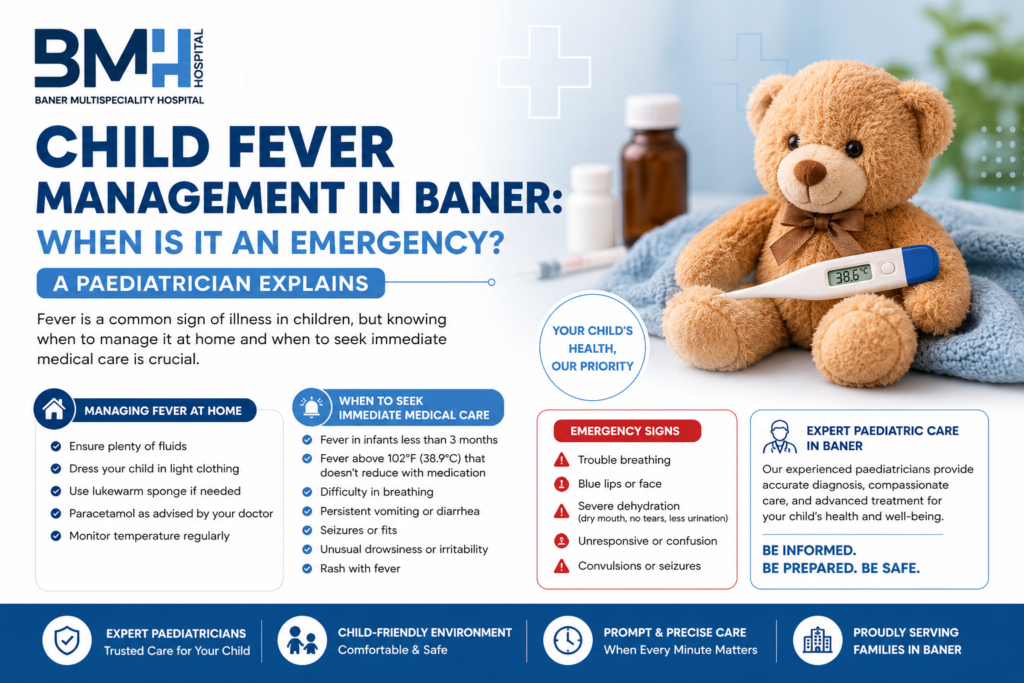
| KEY TAKEAWAYS Fever above 100.4°F (38°C) in any child under 3 months is always a medical emergency — go to hospital immediately. Febrile convulsions occur in 2-5% of Indian children between 6 months and 5 years. Paracetamol is the safe first-line fever reducer for children — ibuprofen is avoided under 6 months. Dr Kapil Jadhav and Dr Sachin Admuthe are the paediatric specialists at Baner Multi-Speciality Hospital. Dengue fever in children peaks in Pune during and after monsoon — watch for platelet drops. Baner hospital’s 24×7 emergency OT and baby warmer unit support critically ill newborns and children. Never give aspirin to children for fever — it causes a rare but fatal condition called Reye’s syndrome. |
Introduction
Fever is the most common reason parents in Baner bring their children to the emergency OPD at night. Most fevers in children are caused by self-limiting viral infections and resolve within three to five days. But some fevers signal a serious underlying condition that requires immediate hospitalisation.
Dr Kapil Jadhav and Dr Sachin Admuthe, paediatric specialists at Baner Multi-Speciality Hospital, explain how to assess your child’s fever at home, when to give fever-reducing medication and — most importantly — which warning signs mean you must go to hospital right now.
| QUICK FACTS Emergency fever threshold (under 3 months): Any temperature above 38°C (100.4°F) Safe paracetamol dose for children: 15 mg per kg body weight every 4-6 hours Febrile convulsion occurrence: 2-5% of children aged 6 months to 5 years Dengue fever peak season in Pune: July to October Paediatric OPD at Baner hospital: Monday to Saturday 24×7 emergency paediatric care: Available at Baner Multi-Speciality Hospital |
Pune Child Fever and Paediatric Health Statistics 2025-2026
| Metric | Data Point | Source |
| Febrile convulsion rate in Indian children (6m-5y) | 2-5% | ICMR 2022 |
| Dengue cases in Maharashtra (annual) | Approx. 22,000 reported (2024) | MoHFW 2024 |
| Under-5 mortality from vaccine-preventable disease | Declining 8% year-on-year | WHO India 2023 |
| Hospitalisation needed for paediatric fever | Approx. 15-20% of all cases | Industry estimate |
| Dengue cases in Pune (monsoon peak) | Avg 3,400-4,200 per season | Industry estimate |
| Paediatric emergency visits in Pune hospitals | Rising 7% year-on-year | Industry estimate |
Fever Temperature Guide for Parents: What the Numbers Mean
| Temperature Range | Interpretation | Recommended Action |
| 37.5 to 38.0°C (99.5-100.4°F) | Low-grade fever | Monitor at home; increase fluids |
| 38.0 to 38.5°C (100.4-101.3°F) | Mild fever | Paracetamol if uncomfortable; monitor |
| 38.5 to 39.5°C (101.3-103.1°F) | Moderate fever | Give paracetamol; review in 24 hours if no improvement |
| Above 39.5°C (103.1°F) | High fever | Paracetamol immediately; consult OPD if not falling |
| Any fever under 3 months age | Always emergency | Go to hospital immediately — no exceptions |
| Above 40°C (104°F) any age | Dangerous high fever | Emergency hospital visit immediately |
When Is a Child’s Fever an Emergency? Warning Signs for Baner Parents
These specific features in a feverish child require immediate attention at Baner Multi-Speciality Hospital’s emergency department — don’t wait for morning OPD.
- Any fever in a baby under 3 months — regardless of how mild the baby looks
- Seizure or convulsion (child shaking, eyes rolling, unresponsive)
- Child is extremely drowsy, unusually difficult to wake or confused
- Severe neck stiffness with fever (possible meningitis)
- Rash that is red, flat, spreading and does not fade when you press a glass on it
- Child refuses all fluids for more than 8 hours (dehydration risk)
- Rapid or laboured breathing even when not crying
- Fever persisting beyond 5 days without improvement
Home Management of Fever in Children: Safe and Proven Steps
Medication
Paracetamol (acetaminophen) is the safe first-line medication for fever in children above 3 months. The dose is 15 mg per kg of body weight every 4-6 hours. Never exceed 5 doses in 24 hours. Ibuprofen is safe from 6 months onwards. Never give aspirin to any child or teenager with fever — the risk of Reye’s syndrome, though rare, is life-threatening.
Hydration and Comfort
- Offer ORS (Oral Rehydration Solution) or simple coconut water frequently
- Breastfeed more frequently for infants — breast milk provides antibodies
- Sponging with lukewarm (not cold) water reduces temperature gently
- Dress the child in light cotton clothing — do not bundle in heavy blankets
- A lukewarm bath can help if temperature is very high and the child is comfortable
Seasonal Fever Awareness in Pune: Monsoon and Post-Monsoon
Baner’s location near the Pavana-Mula riverbed and the Hinjewadi construction zones creates significant stagnant water risk during monsoon, which fuels dengue and malaria. Dr Jadhav’s team sees the highest paediatric fever burden from July through October.
Dengue in children presents differently from adults. A child may have a high fever for 2-5 days, followed by a brief apparent improvement and then a sudden platelet drop — the “warning phase.” Any child with fever for more than 3 days in monsoon Pune must have a dengue NS1 and CBC test, which is available at Baner hospital’s 24×7 laboratory.
Paediatric Services at Baner Multi-Speciality Hospital
| Service | Details | Availability |
| Paediatric OPD | Dr Jadhav and Dr Admuthe | Mon to Sat |
| Paediatric emergency | 24×7 emergency department | Round the clock |
| Baby warmer unit | For preterm and sick newborns | Available |
| Phototherapy | Neonatal jaundice treatment | Available |
| 24×7 pathology lab | CBC, dengue NS1, malaria antigen, CRP | Round the clock |
| Vaccination OPD | IAP immunisation schedule | By appointment |
Frequently Asked Questions
| Q: When should I take my child with fever to hospital in Baner? Take your child immediately if they are under 3 months old with any fever, if they have a seizure, if they have a non-blanching rash, if they are severely drowsy or if they have neck stiffness. For older children, go to hospital if the fever exceeds 39.5°C and does not respond to paracetamol. Q: Is it safe to give ibuprofen and paracetamol together for a child’s fever? Alternating paracetamol and ibuprofen is sometimes recommended by doctors for high fever, but this should only be done under medical guidance. Do not give them simultaneously. Never give ibuprofen to children under 6 months. Q: What causes febrile convulsions in children? Febrile convulsions are caused by a rapid rise in body temperature, not the absolute temperature itself. They occur in 2-5% of children aged 6 months to 5 years and are usually brief and not dangerous. However, any first seizure needs medical evaluation. Q: What is the paediatric OPD timing at Baner Multi-Speciality Hospital? Paediatric OPD runs Monday to Saturday. Dr Kapil Jadhav and Dr Sachin Admuthe alternate morning and evening clinics. For emergencies, the 24×7 emergency department is always available. Q: How is dengue fever in children different from adults? Dengue in children may have milder initial symptoms but carries a higher risk of dengue haemorrhagic fever. Platelet monitoring from day 3 onwards is critical. Any child in Baner with fever during monsoon season should be tested for dengue. |
Conclusion
Most children’s fevers are caused by viral infections and resolve with rest, fluids and paracetamol. But knowing the warning signs — under 3 months, seizures, neck stiffness, non-blanching rash or extreme drowsiness — can be the difference between a safe recovery and a serious complication.
Baner Multi-Speciality Hospital’s paediatric team under Dr Kapil Jadhav and Dr Sachin Admuthe is available for OPD consultations and 24×7 emergency paediatric care.
Book an appointment at banerhospital or visit the emergency department directly for urgent cases.
