Key Takeaways
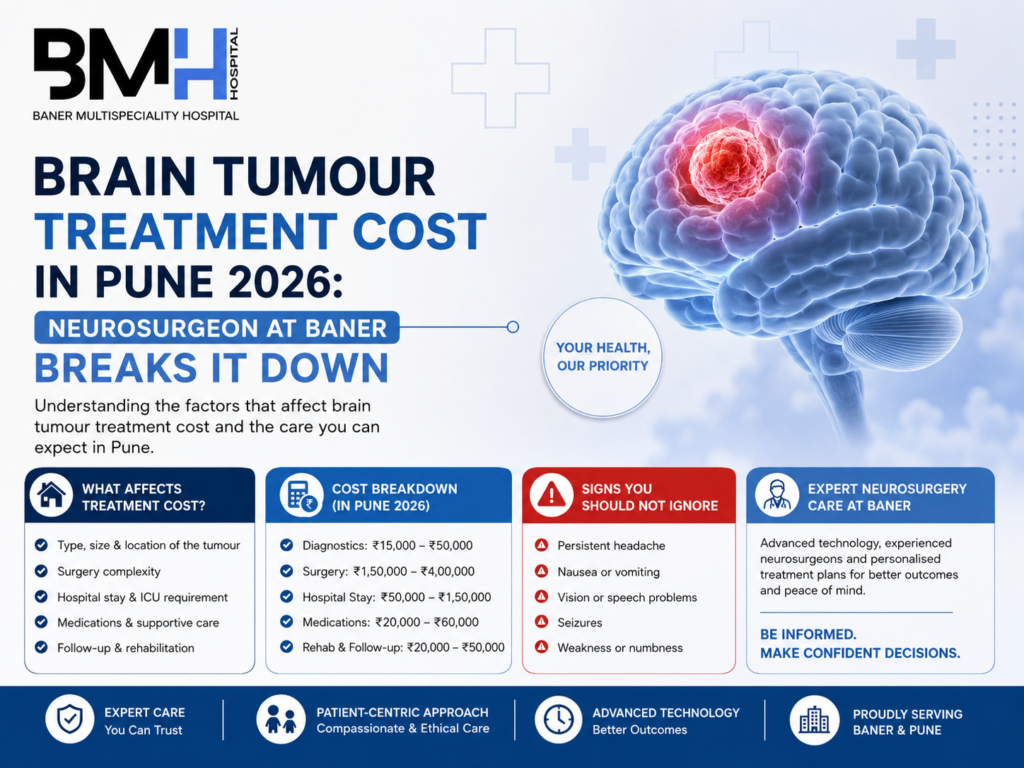
Brain tumour treatment cost in Pune 2026 ranges from INR 2 lakhs (benign tumour surgery) to INR 8 lakhs or more (complex malignant surgery plus adjuvant therapy).
MRI brain with contrast is the primary diagnostic tool and costs INR 4,000 to 8,000 in Pune (Industry estimate).
Meningiomas, pituitary adenomas and acoustic neuromas are the most common benign brain tumours — most are curable with surgery.
Dr Sarang Gothecha, Neuro Surgeon at Baner Multi-Speciality Hospital, handles intracranial and spinal neurosurgical cases.
Most brain tumours (primary or secondary) require a multi-disciplinary approach involving neurosurgery, oncology and radiation therapy.
Early symptoms include new persistent headaches, seizures, vision changes, weakness in limbs and personality changes. Ayushman Bharat PM-JAY covers neurosurgical procedures at empanelled hospitals for eligible patients.
Introduction
A brain tumour diagnosis is one of the most frightening things a family can hear. It raises immediate questions: How serious is it? Can it be removed? What will treatment cost? This blog addresses all of these questions with clinical clarity and compassion.
Dr Sarang Gothecha, Neuro Surgeon at Baner Multi-Speciality Hospital, has reviewed this content to help patients and families in Baner, Aundh, Balewadi and Hinjewadi understand brain tumour types, treatment options and realistic costs in Pune 2026.
Quick Facts
MRI Brain with Contrast Cost in Pune: INR 4,000 to 8,000
Craniotomy (Brain Surgery) Cost in Pune: INR 2,00,000 to 6,00,000
Stereotactic Biopsy Cost in Pune: INR 80,000 to 1,50,000
Post-Surgical Radiation Therapy Cost: INR 1,50,000 to 3,00,000
Chemotherapy (Temozolomide per cycle): INR 10,000 to 30,000 per cycle Insurance Coverage: Most surgeries covered under major health plans
| Metric | Data Point | Source |
| Brain tumour incidence in India (annual) | Approx. 40,000 to 50,000 new cases | Industry estimate / ICMR |
| Most common benign brain tumour | Meningioma | PubMed / WHO Classification |
| Most common malignant primary brain tumour | Glioblastoma (GBM) | WHO CNS Tumour Classification 2021 |
| MRI brain with contrast cost in Pune | INR 4,000 to 8,000 | Industry estimate |
| Craniotomy cost (benign tumour) in Pune | INR 2,00,000 to 3,50,000 | Industry estimate |
| Craniotomy cost (malignant tumour) in Pune | INR 3,50,000 to 6,00,000+ | Industry estimate |
| 5-year survival rate for meningioma | Over 85% | PubMed / CBTRUS |
Types of Brain Tumours: Benign vs Malignant
| Tumour Type | Category | Common Location | Typical Treatment | Prognosis |
| Meningioma | Benign (usually) | Meninges (brain coverings) | Surgical removal | Excellent — over 85% 5-year survival |
| Pituitary adenoma | Benign | Pituitary gland | Transsphenoidal surgery or medical | Excellent with treatment |
| Acoustic neuroma | Benign | Auditory nerve | Surgery or stereotactic radiosurgery | Excellent |
| Low-grade glioma | Borderline malignant | Brain parenchyma | Surgery + radiation | Variable (years to decades) |
| Glioblastoma (GBM) | Highly malignant | Brain parenchyma | Surgery + radiation + chemotherapy | Median 15 to 18 months |
| Brain metastases | Malignant (secondary) | Varied | Surgery or SRS + systemic chemo | Depends on primary cancer |
Symptoms That Warrant Urgent Neurological Evaluation
Brain tumour symptoms vary depending on the tumour’s location and size. Common warning signs include new onset headaches that are progressive (getting worse over days to weeks), especially in the morning, headaches accompanied by vomiting and seizures in someone without a prior seizure history.
Other symptoms include progressive weakness of an arm or leg, speech difficulty, memory lapses or personality changes, vision disturbances (double vision, loss of visual field) and balance or coordination problems. Any of these symptoms — particularly new and progressive over weeks — warrant a brain MRI.
Not every headache is a brain tumour. But a neurosurgeon’s evaluation and an MRI provide definitive reassurance or early diagnosis when something is present.
Pre-Operative Preparation for Brain Tumour Surgery
After the MRI confirms a tumour, a contrast-enhanced CT scan may be done for surgical planning. Blood tests, ECG and anaesthesia fitness evaluation are completed. Some patients require pre-operative steroids (dexamethasone) to reduce brain swelling around the tumour.
Patients are admitted the day before surgery. Anti-epileptic medications are started if seizures are part of the presentation. Blood group typing and cross-matching are done in advance. Dr Gothecha conducts a detailed pre-operative family counselling session explaining the surgical approach, goals, risks and expected outcomes.
Post-Operative Care and Recovery
After craniotomy, patients are monitored in the ICU or HDU for 24 to 48 hours for neuromonitoring. Neurological assessments (ability to move, speak, follow commands) are performed hourly initially. CT brain is repeated at 24 hours to check for bleeding or oedema.
Most patients are transferred to a standard room on day 2 to 3. Hospital stay ranges from 5 to 10 days for most craniotomies. Steroids are gradually tapered. Rehabilitation (physiotherapy, speech therapy) begins in the ward.
Pathology results from the removed tumour take 7 to 10 days. Dr Gothecha presents results in a multi-disciplinary tumour board meeting with oncology and radiation therapy teams to plan any further treatment needed.
Brain Tumour Treatment Cost in Pune 2026: Full Breakdown
| Treatment Component | Description | Cost Range in Pune (INR) |
| MRI Brain with Contrast | Diagnostic and pre-surgical planning | 4,000 to 8,000 |
| Stereotactic biopsy | Tissue sampling without open surgery | 80,000 to 1,50,000 |
| Craniotomy (benign tumour) | Open surgery for meningioma/pituitary | 2,00,000 to 3,50,000 |
| Craniotomy (malignant) | Glioma/GBM surgical debulking | 3,50,000 to 6,00,000 |
| ICU / HDU post-operative | Per day monitoring charges | 5,000 to 12,000/day |
| Radiation therapy (full course) | Post-surgical adjuvant | 1,50,000 to 3,00,000 |
| Chemotherapy per cycle (Temozolomide) | For high-grade glioma | 10,000 to 30,000/cycle |
Insurance for Brain Tumour Treatment in Pune
Craniotomy and neurosurgery are covered under most major health insurance inpatient policies. Ayushman Bharat PM-JAY covers neurosurgical procedures at empanelled hospitals. Chemotherapy and radiation may require separate policy riders in some plans.
CGHS beneficiaries are covered for neurosurgical care at approved rates. Most corporate group policies cover brain tumour surgery with pre-hospitalisation and post-hospitalisation benefits for a defined period.
Brain Tumour Care in Baner, Pune
Dr Sarang Gothecha performs intracranial surgeries including craniotomy for tumour resection, stereotactic biopsy and transsphenoidal pituitary surgery at Baner Multi-Speciality Hospital. The hospital’s ICU and HDU provide post-operative monitoring with 24×7 nursing and neuro team availability.
Complex cases are coordinated with neuro-oncology and radiation therapy centres for comprehensive care. Dr Gothecha facilitates referrals and second opinions from super-specialty centres in Pune when required.
Frequently Asked Questions
A: Brain tumour surgery in Pune 2026 costs INR 2 to 3.5 lakhs for benign tumours (meningioma, pituitary) and INR 3.5 to 6 lakhs or more for malignant tumours, depending on complexity. Additional costs include ICU stay, post-operative radiation (INR 1.5 to 3 lakhs) and chemotherapy. Most major health insurance plans cover craniotomy under inpatient benefits.
A: Warning signs include progressive headaches (especially morning headaches), new-onset seizures, gradual weakness of an arm or leg, speech or memory difficulty, vision changes and unexplained personality changes. These symptoms warrant an urgent brain MRI. Not all of these symptoms mean a tumour — but a neurosurgeon can definitively rule it in or out.
A: No. Many brain tumours are benign (non-cancerous), including meningiomas, pituitary adenomas and acoustic neuromas. These grow slowly and are often curable with surgery. Malignant tumours (like glioblastoma) are aggressive and require a multi-modality approach. The WHO classifies brain tumours from Grade 1 (benign) to Grade 4 (most malignant).
A: Hospital stay after craniotomy is typically 5 to 10 days. Most patients return to light activities within 4 to 6 weeks. Return to work (for non-physical jobs) is typically 6 to 8 weeks. Recovery depends on tumour location, extent of resection and pre-operative neurological status. Physiotherapy and occupational therapy accelerate recovery.
A: Benign tumours like meningiomas can recur in a small percentage of cases, typically over many years. High-grade malignant tumours (GBM) have a higher recurrence rate within months to 2 years. Regular MRI surveillance (every 3 to 6 months for malignant, annually for benign) is essential. Recurrent cases are managed by the multidisciplinary tumour board.
Conclusion
A brain tumour diagnosis is serious — but timely, expert care gives the best outcomes. Understanding treatment options and realistic costs removes the fear of the unknown and helps families make informed decisions.
Dr Sarang Gothecha and the neurosurgery team at Baner Multi-Speciality Hospital provide comprehensive brain tumour care from diagnosis to surgery and post-operative rehabilitation. The hospital supports patients across Baner, Aundh, Balewadi, Wakad and Hinjewadi with advanced neurosurgical facilities and integrated oncology referrals.
If you or a family member is experiencing neurological symptoms or has been told a brain tumour is suspected, book a neurosurgery consultation at banerhospital.com without delay. Early evaluation is the first step toward the best possible outcome.
Medical Disclaimer
This article is for informational purposes only and is not a substitute for professional medical advice, diagnosis or treatment. Always consult a qualified doctor or specialist before making any health-related decisions. The costs, statistics and clinical details mentioned are indicative and subject to change. For personalised advice, please book a consultation at Baner Multi-Speciality Hospital.
Dr Sarang Gotecha
Dr. Sarang Gotecha is a MCh-qualified neurosurgeon practicing at Manipal Hospital, Baner, Pune, with over 12 years of experience. He holds international fellowships from South Korea and Singapore, is a published researcher and specializes in brain tumor surgery, minimally invasive spine surgery and neuroendoscopic procedures. Dr. Gotecha completed his MBBS and MS in General Surgery before pursuing MCh in Neurosurgery - the highest postgraduate degree in the surgical specialty in India. Dr. Gotecha also completed an observership at Tan Tock Seng Hospital, Singapore, gaining additional exposure to advanced intraoperative neuromonitoring, functional neurosurgery techniques.