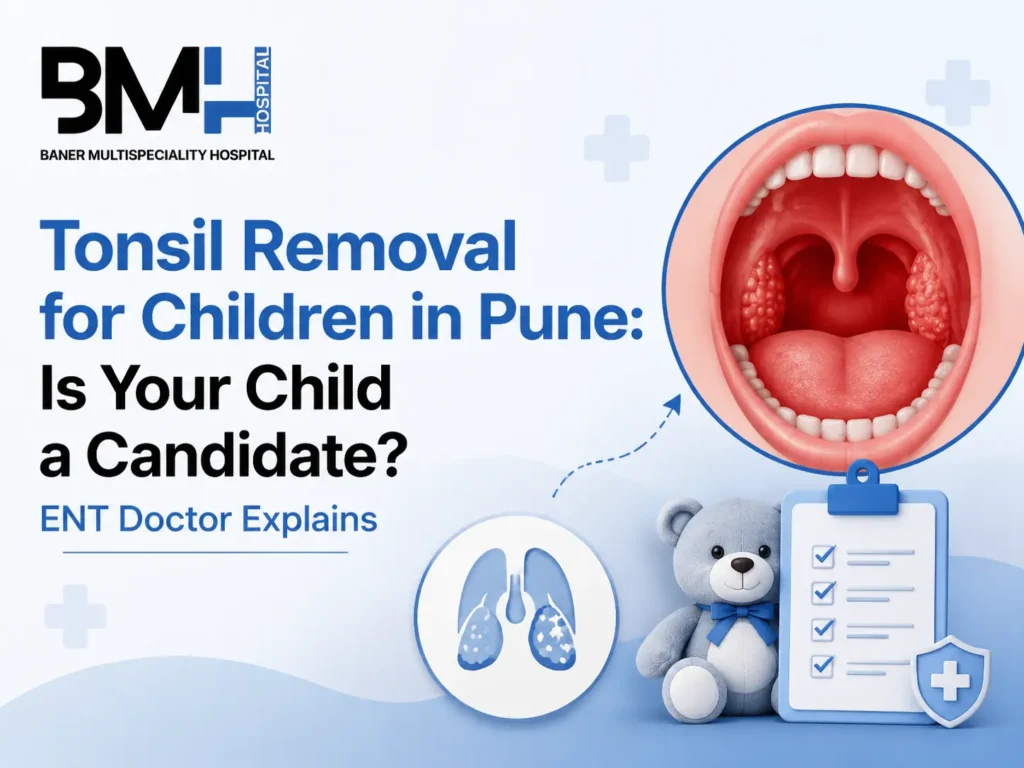
Key Takeaways
Tonsillectomy is recommended for children with 7 or more tonsillitis episodes in one year, or 5 per year for two consecutive years (Paradise Criteria).
Obstructive sleep apnoea (OSA) due to enlarged tonsils is a growing indication, especially in children who snore loudly and are mouth-breathers.
Tonsillectomy with adenoidectomy (adenotonsillectomy) is the most common paediatric surgical procedure performed in India.
Dr Rupali Gulavane, ENT Surgeon at Baner Multi-Speciality Hospital, evaluates and performs paediatric tonsillectomies.
Most children return to normal activity within 10 to 14 days after tonsil removal.
Tonsillectomy cost in Pune 2026 ranges from INR 25,000 to 70,000 depending on technique and hospital category. Post-operative bleeding in the first 24 hours is rare (1 to 2%) — Baner hospital’s 24×7 emergency is equipped to manage it.
Introduction
As a parent, repeated ear infections, snoring that keeps the whole family awake and nights spent soothing a child with a fever and sore throat are exhausting and worrying. Recurring tonsillitis and enlarged tonsils are common in children aged 3 to 12 — and in some cases, surgery is the best answer.
Dr Rupali Gulavane, ENT Surgeon at Baner Multi-Speciality Hospital, has reviewed this parent-focused guide on when tonsillectomy is the right choice for your child, what the surgery involves and what to expect during recovery. This article speaks directly to parents in Baner, Aundh, Balewadi and Hinjewadi.
Quick Facts
Recommended Age for Tonsillectomy: Any age if criteria are met (most common 4 to 10 years)
Tonsillectomy Cost in Pune 2026: INR 25,000 to 70,000
Hospital Stay: 1 to 2 nights
Return to School: 10 to 14 days after surgery
Anaesthesia Type: General anaesthesia (child is fully asleep) Post-Op Dietary Restrictions: Soft foods for 2 weeks
| Metric | Data Point | Source |
| Tonsillectomy annual volume in India | Among top 5 paediatric surgeries | Industry estimate |
| Paradise Criteria recurrence threshold | 7 episodes/year or 5 for 2 years | Paradise et al., NEJM standard |
| OSA prevalence in children with enlarged tonsils | 1 to 5% of all children | PubMed / AHA |
| Tonsillectomy cost in Pune 2026 | INR 25,000 to 70,000 | Industry estimate |
| Post-tonsillectomy bleeding rate | 1 to 2% | PubMed / AAO-HNS |
| Recovery to school after tonsillectomy | 10 to 14 days | Clinical standard |
| Adenotonsillectomy OSA cure rate in children | 70 to 90% | PubMed |
When Does Your Child Need a Tonsillectomy?
Not every child with tonsillitis needs surgery. Tonsils are part of the immune system and serve an important function in early childhood. The question is: at what point do enlarged, repeatedly infected tonsils cause more harm than good?
The Paradise Criteria (the internationally accepted standard) recommend tonsillectomy when a child has 7 or more episodes of tonsillitis in one year, 5 or more per year for 2 consecutive years, or 3 or more per year for 3 consecutive years. Each episode must meet clinical criteria: fever over 38.3 degrees C, cervical lymphadenopathy, tonsillar exudate, or positive strep test.
Obstructive sleep apnoea (OSA) with enlarged tonsils is an increasingly common indication, especially in children who snore loudly, stop breathing briefly during sleep, have restless sleep, and show daytime behavioural problems, poor concentration and mouth breathing.
The Tonsillectomy Procedure: What Happens
The surgery is performed under general anaesthesia — your child will be completely asleep and will feel nothing. Dr Gulavane removes the tonsils through the mouth using a combination of sharp dissection and electrocautery or coblation (radiofrequency energy). Adenoids (at the back of the nose) are often removed at the same time if enlarged.
The procedure takes 20 to 45 minutes. Your child wakes up in the recovery room and is monitored for 1 to 2 hours before transfer to the ward. Most children are discharged the following morning after an overnight observation.
Post-Operative Care: What Every Parent Must Know
Pain is the main challenge after tonsillectomy. Regular paracetamol (and ibuprofen if prescribed) is essential — do not wait for pain to become severe before giving medication. Pain peaks on day 4 to 7 and gradually improves over 2 weeks.
Diet: Cold fluids, ice cream, yoghurt, soft foods (khichdi, mashed dal, banana) are ideal for the first week. Encourage good fluid intake — dehydration worsens pain. Avoid hard, scratchy foods (chips, toast, nuts) for the full 2-week recovery period.
Activity: Restrict vigorous physical activity and school for 10 to 14 days. Baner hospital’s paediatric team provides a school fitness certificate after the follow-up visit at 2 weeks. Watch for post-operative bleeding signs: fresh bright red blood from the mouth, excessive swallowing or spitting of blood — go to the emergency immediately.
| Day After Surgery | Expected Experience | Care Action |
| Day 1 to 2 | Drowsy, mild to moderate throat pain, soft voice | Regular paracetamol, cold fluids, rest |
| Day 3 to 5 | Pain may increase (scab formation), white coating on throat | Continue pain relief, increase fluids, gentle voice rest |
| Day 4 to 7 | Pain peak, mild ear ache (referred pain — normal) | Consistent medication, encourage fluids, avoid exercise |
| Day 8 to 10 | Scabs begin to fall off — slight bleeding may occur | Cold fluids, soft diet, watch for significant bleeding |
| Day 10 to 14 | Pain settling, energy returning, voice normalising | Gradual return to normal diet, review with Dr Gulavane |
| Week 3+ | Full recovery, normal diet and activity | Follow-up appointment to confirm complete healing |
Risk-Benefit Analysis: Is Tonsillectomy Right for Your Child?
Tonsillectomy significantly reduces recurrent throat infections and their impact on school attendance, antibiotic use and family life. For children with OSA, the improvement in sleep quality, behaviour and academic performance after adenotonsillectomy is dramatic in 70 to 90% of cases.
Risks include post-operative bleeding (1 to 2%), rare anaesthetic complications and temporary taste changes. There is no evidence that tonsillectomy weakens the immune system after early childhood — the immune response adapts effectively.
Dr Gulavane takes a conservative approach: surgery is not recommended purely for convenience or for children who clearly fall outside the clinical criteria. A thorough assessment and honest discussion with parents precedes every decision.
Paediatric ENT Services at Baner Multi-Speciality Hospital
Dr Rupali Gulavane’s ENT OPD serves children and adults from Baner, Aundh, Balewadi, Wakad and Hinjewadi with comprehensive ENT care. The hospital’s paediatric-friendly facilities and 24×7 emergency ensure safe management of any post-operative concerns.
Tonsillectomy cost at Baner Multi-Speciality Hospital: INR 25,000 to 60,000 depending on technique (conventional dissection vs coblation) and room category. Most health insurance policies cover tonsillectomy under inpatient surgical benefits for children meeting clinical criteria.
Frequently Asked Questions
A: There is no minimum age — tonsillectomy is performed on children as young as 2 to 3 years when OSA is severe and threatens growth or development. The most common age range for elective tonsillectomy is 4 to 10 years. Younger children require more careful anaesthetic planning, which Baner hospital’s paediatric anaesthesia team provides.
A: Not necessarily. The standard threshold is 7 episodes in one year or 5 per year for two years. Four episodes per year for 2 years falls below the classic threshold, though quality of life, severity of episodes, school absence and antibiotic dependency all influence the decision. Dr Gulavane will help you weigh the risks and benefits based on your child’s specific history.
A: No. Research does not support the idea that tonsillectomy weakens immunity. After early childhood, the tonsils’ immune role becomes redundant — the rest of the immune system adapts effectively. Studies show no increased susceptibility to infections in the years following tonsillectomy.
A: Tonsillectomy removes the palatine tonsils (visible at the back of the throat). Adenotonsillectomy additionally removes the adenoids — lymphoid tissue at the back of the nose, not visible without a scope. Adenoids are removed simultaneously when they are enlarged and contributing to nasal obstruction, snoring or OSA. Dr Gulavane assesses both during the initial ENT examination.
A: Signs of obstructive sleep apnoea in children include loud snoring nightly, pauses in breathing during sleep (observed by parents), restless sleep, sleeping in unusual positions (neck hyperextended), mouth breathing, morning headaches, daytime sleepiness and poor concentration or behavioural problems. A video of your child sleeping can be very helpful to show Dr Gulavane at the consultation.
Conclusion
Tonsillectomy is one of the safest and most effective paediatric surgical procedures when performed for the right indications. It can transform a child’s quality of life — from repeated infections and disrupted sleep to clear breathing and uninterrupted nights.
Dr Rupali Gulavane and the ENT team at Baner Multi-Speciality Hospital provide compassionate, evidence-based tonsil evaluation and surgery for children across Baner, Aundh, Balewadi, Wakad and Hinjewadi. The hospital’s paediatric facilities, 24×7 emergency and post-operative monitoring ensure your child’s safety from start to recovery.
If your child is meeting the criteria for tonsil removal — or if you simply want a specialist opinion — book a paediatric ENT consultation with Dr Gulavane at banerhospital.com today.
Medical Disclaimer
This article is for informational purposes only and is not a substitute for professional medical advice, diagnosis or treatment. Always consult a qualified doctor or specialist before making any health-related decisions. The costs, statistics and clinical details mentioned are indicative and subject to change. For personalised advice, please book a consultation at Baner Multi-Speciality Hospital.
