Table of contents
Key Takeaways
- India accounts for approximately 30% of the global burden of oral cancer — the highest in the world — primarily driven by tobacco and areca nut use.
- Most oral cancers are preceded by a premalignant condition — leukoplakia, erythroplakia or oral submucous fibrosis — that is detectable and treatable years before malignancy.
- A non-healing mouth ulcer persisting beyond 3 weeks is an oral cancer red flag and requires immediate biopsy.
- Dr Prashant Kulkarni at Baner hospital performs oral cancer screening, biopsy, excision and onco-surgical coordination for oral cavity tumours.
- Early-stage oral cancer (Stage I-II) has a 5-year survival rate exceeding 80%; late-stage diagnosis drops this to below 30%.
- Gutka, pan masala, supari and tobacco (smoked and smokeless) are the primary risk factors in the Pune-Maharashtra population.
Introduction
Oral cancer — malignancy arising in the lips, tongue, floor of the mouth, cheeks, gums or hard palate — is India’s most common cancer in men and among the top five cancers in women. The WHO estimates that India reports approximately 1.3 lakh new oral cancer cases each year, accounting for nearly 30% of the world’s oral cancer burden.
The epidemiology in Maharashtra is particularly concerning. The state’s historically high rates of gutka, pan masala, tobacco and areca nut consumption — despite partial bans — continue to sustain an elevated oral cancer incidence in urban Pune as well as in smaller towns across the district. At Baner Multi-Speciality Hospital, Dr Prashant Kulkarni, Oral and Maxillofacial Surgeon, conducts oral cancer screenings, biopsies and surgical management as part of a multi-disciplinary oncology service coordinated with Dr Bhushan Bhalgat, Onco Surgeon.
This article explains the warning signs of oral cancer, the premalignant conditions that precede it, the biopsy pathway and why early detection saves lives.
Quick Facts
| Parameter | Data |
| Annual new oral cancer cases, India | ~1.3 lakh (WHO estimate) |
| India’s share of global oral cancer burden | ~30% — highest in the world |
| 5-year survival, Stage I-II oral cancer | >80% with appropriate treatment |
| 5-year survival, Stage III-IV oral cancer | 30–50% — significantly worse |
| Primary risk factor in Maharashtra | Tobacco (smoked + smokeless), areca nut, gutka, pan masala |
| Most common oral cancer site | Tongue (most common), floor of mouth, buccal mucosa |
1. Premalignant Conditions: The Warning Stage
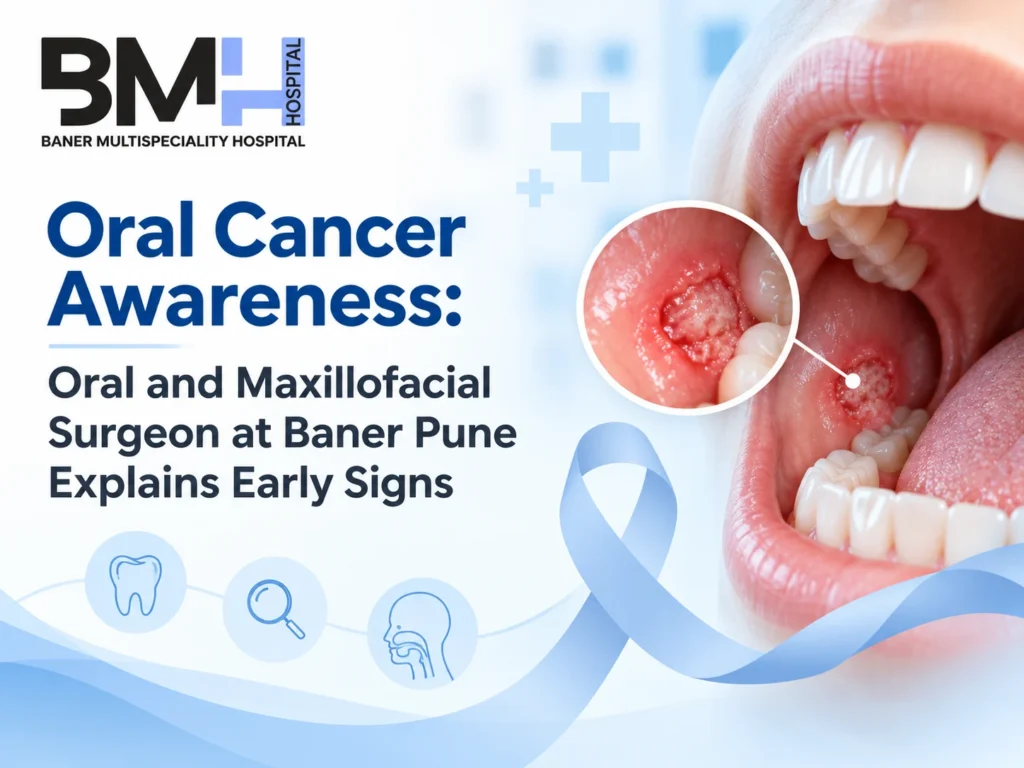
Oral cancer rarely arises de novo from normal mucosa. In the majority of cases, a premalignant lesion is present for months to years before malignant transformation occurs. Recognising and treating these conditions is the single most effective strategy for reducing oral cancer mortality.
| Condition | Appearance | Malignant Transformation Risk | Management |
| Leukoplakia | White patch, cannot be rubbed off | 5–17% over 10 years (higher in erythroleukoplakia) | Biopsy mandatory; excision if dysplasia found |
| Erythroplakia | Red velvety patch | 50% risk of carcinoma in situ or invasive cancer at biopsy | Urgent biopsy and excision |
| Oral submucous fibrosis (OSMF) | Blanching, fibrotic bands, restricted mouth opening | 7–13% malignant transformation | Intralesional steroids, physiotherapy, habit cessation |
| Actinic cheilitis | Lip changes from sun exposure — scaly, pale lip vermilion | ~10% risk | Lip shave or laser ablation |
| Lichen planus (erosive type) | Erosive, atrophic — higher risk than reticular type | ~1% per year | Regular monitoring; biopsy of changing lesions |
2. Warning Signs of Oral Cancer
Dr Kulkarni uses the following framework to explain oral cancer warning signs to patients at Baner hospital’s oral surgery OPD. Any of these features persisting beyond 3 weeks warrants immediate clinical assessment and biopsy.
- A mouth ulcer or sore that does not heal within 3 weeks, especially if painless in the early stages.
- A white, red or mixed red-and-white patch in the mouth that cannot be wiped off.
- A lump, thickening or rough area in the mouth, on the lip or on the gum.
- Difficulty chewing, swallowing or moving the tongue or jaw.
- Numbness or pain in the lip, tongue or other area of the mouth without an obvious dental cause.
- A persistent sore throat or the feeling that something is caught in the throat.
- A lump in the neck — which may represent a lymph node metastasis even when the primary oral lesion appears small.
- Unexplained loose teeth or poorly fitting dentures not explained by dental disease.
- Persistent bad breath not explained by dental hygiene.
3. The Biopsy Pathway at Baner Hospital
Biopsy — the microscopic examination of tissue removed from a suspicious lesion — is the definitive investigation for oral cancer and its precursors. Dr Kulkarni performs incisional and excisional biopsies at Baner hospital’s oral surgery OPD under local anaesthesia, with results available from the hospital’s histopathology service.
| Step | What Happens | Time Required |
| Clinical examination | Complete intraoral and neck examination; photography of lesion | First appointment (30–45 minutes) |
| Biopsy (incisional) | Tissue sample from representative area of lesion under local anaesthesia | Procedure: 15–20 minutes |
| Histopathology report | Grading: normal / dysplasia (mild/moderate/severe) / carcinoma in situ / invasive | 5–7 working days |
| Staging (if malignant) | CT/MRI neck and chest; PET scan if indicated; tumour board review with Dr Bhalgat | 5–10 days after biopsy report |
| Treatment planning | Surgery / radiotherapy / chemotherapy based on stage and histology | Multi-disciplinary decision |
4. Treatment of Oral Cancer at Baner Hospital
Early-stage oral cancers (Stage I and II) are primarily managed with surgery — wide local excision with adequate margins — which Dr Kulkarni performs in Baner hospital’s major OT. Reconstruction of the surgical defect uses local flaps, free tissue transfer (in coordination with plastic surgery) or prosthetic rehabilitation, depending on the extent of resection.
Advanced-stage oral cancers (Stage III and IV) require a multi-disciplinary approach involving oncosurgery (Dr Bhalgat), radiotherapy and medical oncology. Baner hospital coordinates referrals to affiliated oncology centres for radiation and chemotherapy while managing the surgical components on-site.
5. Risk Factor Cessation: The Most Effective Prevention
Tobacco and areca nut cessation reduces oral cancer risk by up to 90% within 10 years of stopping. Dr Kulkarni incorporates habit cessation counselling into every new patient consultation. Support services for tobacco cessation are available through the National Health Portal’s quitline (1800-11-2356) and through Baner hospital’s physician OPD for pharmacotherapy (nicotine replacement, varenicline or bupropion as appropriate).
| Risk Factor | Associated Oral Cancer Risk | Cessation Benefit |
| Smoked tobacco (bidi, cigarette) | 3–10x increased oral cancer risk | Risk approaches non-smoker level in 10 years |
| Smokeless tobacco (khaini, mawa, zarda) | 5–20x increased risk — highest for floor-of-mouth and tongue | Significant risk reduction within 5 years of cessation |
| Gutka / pan masala (areca nut content) | 7–25x increased risk; OSMF precedes malignancy in many users | OSMF may partially regress; cancer risk reduces significantly |
| Alcohol (combined with tobacco) | Synergistic — multiplies risk 15x when both used together | Cessation of both produces greatest risk reduction |
| HPV (especially type 16) | Oropharyngeal cancer (tonsil, base of tongue) — not classic oral cavity | HPV vaccination in adolescents reduces oropharyngeal cancer risk |
6. Annual Oral Cancer Screening at Baner Hospital
Dr Kulkarni recommends annual oral cancer screening for all adults over 30 who use tobacco in any form, consume gutka or pan masala, drink alcohol regularly or have a prior history of premalignant oral lesions. Oral cancer screening involves a 10-minute systematic visual and tactile examination of all oral mucosal surfaces — it is painless, quick and available as part of a general surgical OPD consultation at Baner hospital.
Frequently Asked Questions
1. I have a small mouth ulcer that has been there for 4 weeks but it doesn’t hurt much. Should I be concerned?
Yes. Painlessness does not mean benign. Early oral cancers are frequently asymptomatic or mildly uncomfortable. A non-healing ulcer beyond 3 weeks requires clinical assessment and biopsy regardless of pain level. Visit Dr Kulkarni’s oral surgery OPD at Baner hospital this week.
2. I have a white patch in my mouth. Is it definitely cancer?
Not necessarily. Leukoplakia (white patch) has a 5–17% malignant transformation rate — but it requires biopsy to determine the presence or absence of dysplasia. Some white patches are candidal infection, frictional keratosis or other benign conditions. Biopsy is the only way to determine the correct diagnosis and management.
3. Can oral cancer spread to the neck lymph nodes?
Yes. Lymph node metastasis in the neck is the most important prognostic factor in oral cancer. This is why all oral cancer patients at Baner hospital receive a clinical and CT neck examination — even when the primary tumour appears early — before a management plan is finalised.
4. Is oral cancer surgery disfiguring?
Early-stage surgery is typically not significantly disfiguring. Dr Kulkarni performs wide excision with reconstruction designed to preserve form and function. Advanced cases requiring jaw resection or extensive soft tissue excision require more complex reconstruction — which is planned in advance with plastic surgery involvement.
5. Is the oral cancer screening at Baner hospital a separate appointment or part of a regular consultation?
Screening can be incorporated into a routine oral surgery or general surgery OPD appointment. Patients do not need a specific referral letter. Call Baner hospital OPD to book a consultation with Dr Kulkarni.
Conclusion
Oral cancer is largely preventable and, when caught early, is highly curable. The window of intervention — from premalignant lesion to early invasive cancer — can span several years and is the optimal time for treatment with the best functional and survival outcomes.
Annual oral cancer screening for tobacco users, combined with immediate assessment of any suspicious oral lesion, is the most effective individual action any Baner-area resident can take. Book an oral surgery OPD appointment at Baner Multi-Speciality Hospital via banerhospital.com/oral-maxillofacial-surgery.
