Key Takeaways
- Simple wisdom tooth extraction in Pune costs approximately ₹2,000–₹5,000; surgical extraction of an impacted tooth ranges from ₹8,000 to ₹25,000 per tooth.
- Impacted wisdom teeth that cause recurrent pain, pericoronitis, adjacent tooth damage or cysts should be surgically removed — watchful waiting risks complications.
- Most wisdom tooth extractions at Baner hospital are day-care procedures under local anaesthesia or conscious sedation; general anaesthesia is rarely needed.
- Dr Prashant Kulkarni performs surgical extractions including deeply impacted, partially erupted and horizontal impactions.
- Dry socket (alveolar osteitis) is the most common post-extraction complication — risk is higher in smokers and women on oral contraceptives.
- Recovery after surgical extraction is typically 3–5 days of discomfort; most patients return to desk work within 2–3 days.
Introduction
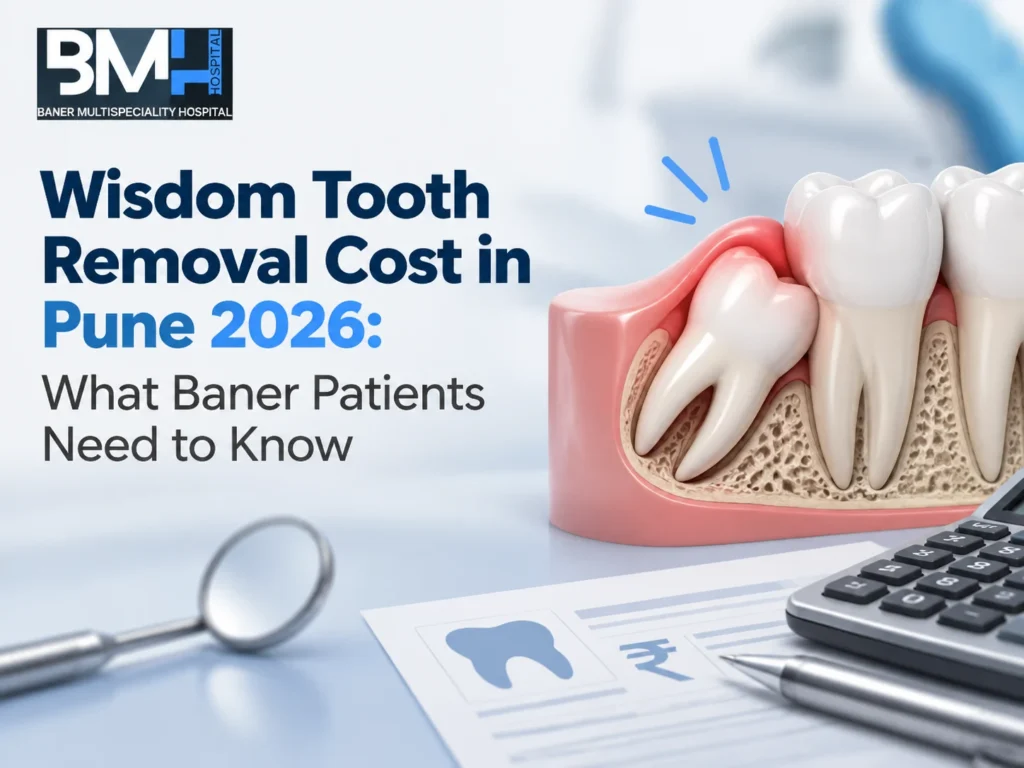
Wisdom teeth — the third molars, which typically erupt (or attempt to erupt) between ages 17 and 25 — are the most commonly extracted teeth in clinical dental practice. For a large proportion of the population, the jaw is too small to accommodate these teeth fully, resulting in impaction: a condition where the tooth remains partially or completely trapped within the jawbone or gum tissue.
Impacted wisdom teeth are a significant source of dental morbidity in young adults across Pune. Recurrent pericoronitis (infection of the gum flap over a partially erupted tooth), decay of the adjacent second molar due to inaccessibility for cleaning, cyst formation and jaw pain are the most common complications that bring patients to Dr Kulkarni’s oral surgery OPD at Baner Multi-Speciality Hospital.
This guide provides a practical overview of wisdom tooth types, indications for removal, realistic cost estimates for Pune in 2026, anaesthesia options and what to expect during recovery.
Quick Facts
| Parameter | Data |
| Population requiring wisdom tooth extraction | ~35–45% of adults have at least one symptomatic or problematic wisdom tooth (industry estimate) |
| Age of eruption | 17–25 years in most patients; some erupt later or not at all |
| Most common indication for removal | Recurrent pericoronitis and impaction with pain |
| Number of wisdom teeth | 4 (one in each quadrant); some people have fewer or none |
| Day-care eligibility | >90% of wisdom tooth extractions — no overnight admission required |
| Return to work | Desk/light work: 2–3 days; physical work: 5–7 days |
1. Types of Wisdom Tooth Impaction
The degree of impaction determines the complexity of extraction and the procedure’s cost. Dr Kulkarni classifies impacted wisdom teeth based on the Pell-Gregory and Winter’s classification systems, which assess depth within the jawbone and angulation of the tooth.
| Impaction Type | Description | Extraction Complexity | Indicative Cost Range |
| Erupted (non-impacted) | Tooth fully visible in mouth, may have infection or decay | Simple — forceps extraction | ₹2,000 – ₹5,000 |
| Soft tissue impaction | Crown erupted through bone but covered by gum flap | Soft tissue incision needed | ₹5,000 – ₹10,000 |
| Partial bony impaction | Partially covered by jawbone; requires bone removal | Surgical; moderate complexity | ₹10,000 – ₹18,000 |
| Complete bony impaction (mesioangular) | Fully encased in bone; angled toward adjacent tooth | Surgical; requires sectioning | ₹15,000 – ₹25,000 |
| Horizontal impaction | Tooth lying completely horizontal in bone | Most complex; full surgical procedure | ₹18,000 – ₹30,000 |
2. When Should a Wisdom Tooth Be Removed?
Not all wisdom teeth require removal. An asymptomatic, fully erupted and functional wisdom tooth with adequate hygiene access does not need to be extracted. However, extraction is clearly indicated in the following circumstances.
- Recurrent pericoronitis: Two or more episodes of infection of the gum flap over a partially erupted wisdom tooth is a clear indication for removal.
- Adjacent tooth damage: Impacted wisdom teeth frequently cause cavities or bone loss on the distal (back) surface of the second molar — extracting the wisdom tooth early prevents irreversible second molar damage.
- Cyst or tumour formation: Dentigerous cysts form around the crowns of impacted teeth and can erode significant amounts of jawbone if untreated.
- Resorption of adjacent roots: The pressure of an impacted wisdom tooth can dissolve the root structure of the second molar — detectable on X-ray.
- Orthodontic requirement: Wisdom teeth are sometimes removed to facilitate orthodontic tooth movement or to reduce relapse after braces.
- Pain without infection: Pressure pain from an impacted wisdom tooth, even without acute infection, is an indication for surgical review.
3. Anaesthesia Options at Baner Hospital
The choice of anaesthesia is tailored to the procedure complexity, patient anxiety level and medical fitness. Dr Kulkarni discusses all options during the pre-operative consultation.
| Anaesthesia Type | Description | Suitable For | Additional Cost |
| Local anaesthesia (LA) | Injections to numb the tooth and surrounding bone; fully conscious patient | Most wisdom tooth extractions — first-line choice | Included in procedure cost |
| Conscious sedation (IV midazolam) | Patient is relaxed and drowsy but breathing independently; LA also given | Anxious patients; moderately complex impactions | ₹3,000 – ₹7,000 additional |
| Nitrous oxide inhalation sedation | Inhalation of laughing gas; mild sedation; rapid recovery | Mild dental anxiety; not suitable for all patients | ₹2,000 – ₹4,000 additional |
| General anaesthesia (GA) | Full unconsciousness; intubation; HDU monitoring | Multiple impactions, severe phobia, medically complex patients | ₹15,000 – ₹30,000 additional (OT + anaesthetist) |
4. What to Expect During and After Surgery
Dr Kulkarni walks every patient through a detailed pre-operative explanation before any wisdom tooth procedure. The surgical appointment at Baner hospital typically takes 30–90 minutes depending on complexity. The patient is observed briefly post-procedure and discharged with a written aftercare sheet.
- Day of surgery: Bite firmly on gauze for 30–45 minutes after the procedure to control bleeding. Avoid spitting, rinsing vigorously or using straws — suction pressure can dislodge the blood clot (dry socket risk).
- First 24 hours: Cold compresses to the jaw (15 minutes on, 15 off) to reduce swelling. Soft food only — yoghurt, rice, khichdi. Avoid hot food and beverages.
- Days 2–3: Maximum swelling and some bruising are normal. Paracetamol or NSAIDs (as prescribed) for pain. Warm salt water rinses begin from 24 hours post-surgery.
- Days 4–7: Significant improvement. Stitches dissolve in 7–10 days if absorbable sutures are used; non-absorbable sutures require removal at the 7-day review.
- Red flags: Severe pain that worsens after Day 3 (rather than improving) suggests dry socket — return to Baner hospital for dressing.
5. Insurance and Cost Planning
Wisdom tooth extraction is classified as a dental surgical procedure. Most standalone health insurance policies exclude dental treatment; however, oral surgery performed at a hospital (as at Baner hospital) under sedation or general anaesthesia often falls within the scope of medical insurance rather than dental insurance. Patients with employer-provided group health insurance or CGHS coverage should check their policy document and submit a pre-authorisation request through Baner hospital’s billing team.
| Cost Component | Indicative Range (Pune 2026) |
| OPG (panoramic X-ray) — initial assessment | ₹600 – ₹1,500 |
| CBCT scan (if complex impaction) | ₹2,500 – ₹5,000 |
| Surgeon fee (per tooth) | ₹5,000 – ₹20,000 (complexity-dependent) |
| OT / procedure room charges | ₹3,000 – ₹8,000 |
| Sedation / anaesthetist (if applicable) | ₹3,000 – ₹30,000 (type-dependent) |
| Medications (7-day course) | ₹500 – ₹1,500 |
| Review appointment | Usually included in surgical fee |
6. Local Context: Why Patients from Across Western Pune Choose Baner Hospital
Baner Multi-Speciality Hospital’s oral and maxillofacial surgery department handles a range of procedures beyond routine dental extractions — including jaw fractures, facial trauma from road accidents, cyst and tumour removal, and orthognathic surgery. Dr Kulkarni’s dual training in surgery and dentistry allows him to manage the full spectrum of oral surgical conditions for patients from Baner, Aundh, Balewadi, Wakad and the Hinjewadi IT corridor.
Frequently Asked Questions
1. Can all four wisdom teeth be removed at the same time?
Yes. Removing all four under a single general anaesthetic session is an option for patients with four impacted teeth, avoiding multiple recovery episodes. However, simultaneous removal of all four under local anaesthesia alone is challenging — this requires careful planning with Dr Kulkarni.
2. I am on blood thinners. Can I still have wisdom tooth surgery?
Most patients on antiplatelet agents (aspirin, clopidogrel) can have extractions without stopping medication, with appropriate local haemostatic measures. Patients on warfarin or DOACs (rivaroxaban, apixaban) need their INR checked and medication timing adjusted in coordination with their prescribing physician. Discuss this at the pre-operative consultation.
3. My wisdom tooth doesn’t hurt. Does it still need to come out?
Not necessarily. Asymptomatic, normally erupted wisdom teeth with no adjacent damage or pathology can be monitored. If CBCT or OPG X-rays show impaction with early-stage second molar root resorption or cyst formation, extraction is recommended even in the absence of pain.
4. How long does a surgical extraction take at Baner hospital?
A straightforward soft-tissue or partial bony impaction takes 20–40 minutes. A complex horizontal or deeply impacted tooth may take 45–75 minutes. Total time at hospital including preparation, recovery and post-procedure observation is typically 2–3 hours.
5. What is dry socket and how common is it?
Dry socket (alveolar osteitis) occurs when the blood clot in the extraction socket is lost or fails to form, exposing the bone to air, food and bacteria. It causes severe, escalating pain typically beginning on Day 3–4. It occurs in approximately 2–5% of extractions and up to 25% of impacted lower wisdom tooth extractions. Treatment involves professional cleaning and medicated dressings at Baner hospital. Smoking doubles the risk.
Conclusion
Wisdom tooth removal, when needed, is one of the most commonly performed and well-tolerated oral surgical procedures — particularly when done early, before significant complications develop. The combination of local anaesthesia, sedation options and skilled surgical technique at Baner hospital ensures that the majority of patients have a comfortable experience and quick recovery.
To assess your wisdom teeth or schedule a surgical consultation, book an appointment with Dr Prashant Kulkarni at Baner Multi-Speciality Hospital via banerhospital.com/oral-maxillofacial-surgery.
Medical Disclaimer
This article is for informational purposes only and is not a substitute for professional medical advice, diagnosis or treatment. Always consult a qualified doctor or specialist before making any health-related decisions. The costs, statistics and clinical details mentioned are indicative and subject to change. For personalised advice, please book a consultation at Baner Multi-Speciality Hospital.
