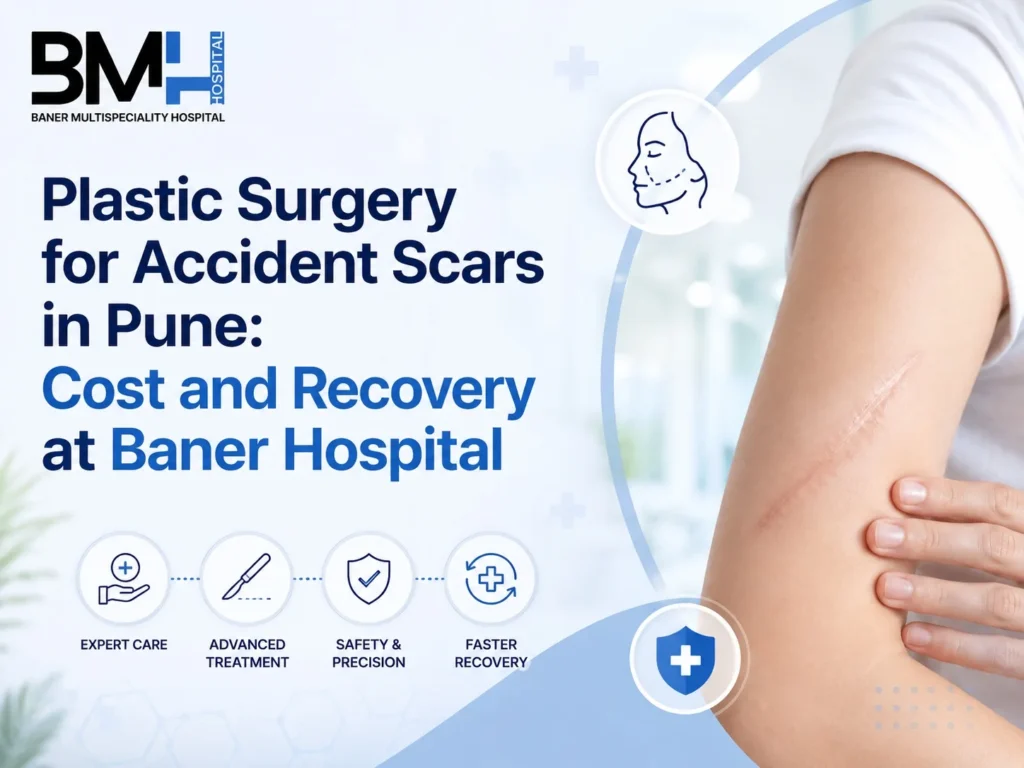
Key Takeaways
- Scar revision surgery in Pune typically costs ₹20,000–₹1,50,000 depending on scar size, type and technique required.
- Road traffic accidents are the leading cause of facial and limb scarring requiring plastic surgery in western Pune.
- Keloid and hypertrophic scars are biologically distinct conditions requiring different treatment protocols.
- Early intervention (within 6–12 months of injury) produces significantly better outcomes than delayed scar revision.
- Dr Bhagyashree Telele at Baner hospital offers scar revision, Z-plasty, skin grafting and intralesional injections under one roof.
- Most scar revision procedures are day-care or short-stay — full hospitalisation is rarely required.
Introduction
Pune’s dense road network — particularly the stretches along Baner Road, SB Road, Aundh-Ravet BRT Road and the Hinjewadi Link Road — generates a significant volume of road traffic accident (RTA) injuries each year. The World Health Organisation estimates that India accounts for approximately 11% of global road accident deaths despite having only 1% of the world’s vehicles. Many survivors of RTAs in western Pune are left with significant scarring of the face, hands, arms and lower limbs that affects both function and appearance.
Plastic and reconstructive surgery for scar management is a specialised discipline that goes far beyond cosmetic concern. Scars in certain locations restrict joint movement, cause chronic pain and nerve sensitivity, and have a profound impact on mental health and occupational function. This guide, prepared with input from Dr Bhagyashree Telele, Plastic and Reconstructive Surgeon at Baner Multi-Speciality Hospital, covers the types of scars, available treatments, costs and realistic recovery expectations for patients across the Baner-Aundh-Balewadi catchment area.
Quick Facts
| Leading cause of traumatic scarring in Pune | Road traffic accidents (two-wheeler and pedestrian) |
| Most commonly affected areas | Face, hands and forearms, lower limbs, chest |
| Keloid prevalence in India | ~6–16% of scar-forming wounds (ICMR estimate) |
| Typical scar maturation time | 12–18 months before full scar revision is attempted |
| Day-care procedure eligibility | ~70% of scar revision procedures do not require overnight admission |
| Baner hospital plastic surgery OPD | Available — appointment required; Dr Bhagyashree Telele |
1. Understanding Scar Types
Not all scars are alike, and treatment selection depends on accurate scar classification. Dr Telele explains that the most commonly encountered scar types in post-RTA patients at Baner hospital fall into four categories.
| Scar Type | Characteristics | Common Cause | Treatment Approach |
| Flat (normotrophic) scar | Pale, flat, matches skin surface | Clean lacerations, surgical wounds | Silicone gel, sun protection, reassurance |
| Hypertrophic scar | Raised, red, stays within wound boundary | Burns, deep wounds, RTA abrasions | Compression, silicone, intralesional steroids |
| Keloid | Raised, extends beyond wound boundary, recurs | Genetic predisposition + wound | Steroids, surgery + adjuvant therapy, cryotherapy |
| Contracture scar | Pulls skin tight, limits movement | Burns, skin loss over joints | Z-plasty, skin grafting, tissue expansion |
| Atrophic scar | Sunken, pitted (e.g. acne, chickenpox) | Inflammatory skin disease | Dermal fillers, laser (dermatology referral) |
2. Scar Revision Surgery: Techniques Available at Baner Hospital
Scar revision refers to a range of surgical procedures designed to improve the appearance and function of a scar. Dr Telele emphasises that revision does not erase a scar — it replaces an unfavourable scar with one that is less noticeable, more functional and more consistent with natural skin tension lines.
- Simple scar excision and re-closure: The scar is surgically removed and the wound is re-closed with meticulous layered suturing under local anaesthesia. Best suited for wide or irregular flat scars.
- Z-plasty: A geometric re-arrangement of skin flaps that breaks up a straight-line scar, redirects tension and is particularly effective for contracture scars over joints.
- W-plasty / geometric broken line closure: Irregularises the scar to make it less visible to the human eye; useful for longer facial scars.
- Skin grafting: A section of skin from a donor site (usually thigh or abdomen) is transferred to cover a defect. Split-thickness or full-thickness grafts are chosen based on the recipient site requirements.
- Local flap reconstruction: Healthy adjacent tissue is rotated to cover a scarred area — provides better colour and texture match than grafts. Used for facial and hand reconstruction.
- Tissue expansion: A silicone balloon is implanted under healthy skin near the scar and gradually inflated over weeks to generate extra skin for reconstruction. Used for larger scalp or facial defect coverage.
3. Non-Surgical Scar Management Options
Many patients do not require surgery. Dr Telele notes that early-phase scars — those less than 6 months old and still in the active remodelling phase — often respond well to non-surgical treatments, potentially avoiding the need for surgery altogether.
| Treatment | Mechanism | Best for | Duration |
| Silicone gel sheets | Reduces scar hydration, modulates collagen | Hypertrophic scars, fresh surgical scars | 3–6 months continuous wear |
| Intralesional triamcinolone (steroid injection) | Reduces collagen overproduction | Keloids, hypertrophic scars | Every 4–6 weeks x 3–6 sessions |
| Compression therapy | Reduces vascular supply to scar | Post-burn hypertrophic scars | 6–12 months continuous |
| Cryotherapy | Freezes and reduces raised scar tissue | Small keloids, hypertrophic scars | 1–4 sessions, 4–6 weeks apart |
| Intralesional 5-fluorouracil (5-FU) | Inhibits fibroblast proliferation | Resistant keloids | 3–6 sessions |
| Laser therapy (referral to dermatology) | Targets vascularity and collagen remodelling | Red, vascular scars | Multiple sessions |
4. Cost of Scar Treatment in Pune 2026
Cost varies substantially depending on scar size, number of lesions, technique required, anaesthesia type and whether the procedure is day-care or inpatient. The following figures are indicative ranges for Baner-area hospitals. All patients are advised to obtain a formal written estimate after in-person assessment by Dr Telele, as accurate costing requires direct examination.
| Procedure | Indicative Cost Range (Pune 2026) | Anaesthesia | Stay |
| Intralesional steroid injection (per session) | ₹1,500 – ₹4,000 | None / topical | OPD |
| Simple scar excision and closure | ₹15,000 – ₹35,000 | Local | Day care |
| Z-plasty (small scar) | ₹25,000 – ₹60,000 | Local / sedation | Day care |
| Z-plasty (large contracture, joint) | ₹60,000 – ₹1,20,000 | General | 1–2 days |
| Split-thickness skin graft (small area) | ₹30,000 – ₹70,000 | General / spinal | 2–3 days |
| Full-thickness skin graft (facial/hand) | ₹50,000 – ₹1,50,000 | General | 2–4 days |
| Local flap reconstruction (face/hand) | ₹80,000 – ₹2,00,000 | General | 2–5 days |
Note: Figures are indicative estimates for 2026. Insurance applicability depends on policy terms — post-traumatic scar surgery is covered under many group health insurance policies, especially when documented as secondary to a road accident. Patients should obtain a detailed injury report and surgical recommendation letter from Baner hospital for insurance pre-authorisation.
5. When Is the Right Time for Scar Revision?
Timing is one of the most critical factors in scar revision outcomes. Dr Telele advises patients that surgical intervention should generally be deferred until scar maturation is complete — typically 12–18 months after the initial wound. During this period, the scar undergoes natural remodelling and may soften and flatten without any intervention.
However, non-surgical treatment should begin early — within 4–6 weeks of wound closure. Silicone gel application, compression and sun protection started early can significantly improve the final scar quality. Contracture scars affecting joint movement may require earlier surgical intervention to prevent long-term functional disability, particularly in children whose growth can worsen contractures.
6. Psychological Impact of Scarring and Support at Baner Hospital
Scarring — particularly facial scarring in young adults — carries a significant psychological burden. Studies published in PubMed-indexed journals have documented high rates of anxiety, depression and post-traumatic stress disorder (PTSD) in RTA survivors with visible scars. Dr Neha Jaswani, Psychiatrist at Baner hospital, is available for mental health support as part of the multi-disciplinary RTA rehabilitation pathway.
Patients should feel comfortable discussing the psychological impact of their injuries with their plastic surgery team. Referral to psychiatric support is not a sign of weakness — it is an integral component of comprehensive scar rehabilitation.
7. Local Context: Baner Hospital’s Plastic Surgery Infrastructure
Baner Multi-Speciality Hospital’s plastic surgery service is equipped with a major operation theatre, image-guided surgical capabilities, HDU for post-operative monitoring and a dedicated wound management OPD. The hospital’s proximity to Baner, Aundh, Balewadi, Hinjewadi and Wakad makes it accessible to the large number of RTA patients transported from NH-48, the Baner-Pashan Link Road and the Aundh-Ravet BRT Road corridors.
Dr Telele conducts pre-operative consultations that include detailed scar photography, functional assessment and a structured treatment timeline, ensuring patients have realistic expectations before committing to any surgical procedure.
Frequently Asked Questions
1. Can all scars be completely removed through surgery?
No. Scar revision improves the appearance and function of a scar — it does not eliminate it entirely. The goal is to replace a problematic scar with one that is flatter, less pigmented, more functional and less noticeable in daily life.
2. Will my insurance cover scar revision surgery?
Many group health and personal accident policies cover reconstructive scar revision when it is related to a documented road accident. Purely cosmetic scar procedures are generally not covered. Dr Telele’s team can provide the clinical documentation required for insurance pre-authorisation.
3. How long does recovery take after skin graft surgery?
The graft usually takes (adheres) within 5–7 days. Donor site heals in 2–3 weeks. Full activities are usually resumed in 4–6 weeks. Sun protection and compression should continue for 3–6 months after the procedure.
4. I have a keloid on my shoulder. Can it recur after surgery?
Keloids have a significant recurrence rate with surgery alone. Dr Telele combines scar excision with adjuvant treatments (post-operative steroid injections, compression and sometimes radiation therapy in resistant cases) to reduce recurrence risk. This combination approach significantly improves long-term outcomes.
5. At what age can children undergo scar revision?
Functional scar revision (e.g. release of contractures affecting movement) can be performed at any age if clinically indicated. Purely aesthetic scar revision is generally deferred until the child is older and able to participate in the decision-making process.
6. Is scar revision available as a day-care procedure at Baner hospital?
Yes. The majority of scar revision procedures — including simple excision, intralesional injections, Z-plasty for small scars and cryotherapy — are performed as day-care under local anaesthesia. Larger procedures requiring general anaesthesia involve an overnight stay.
Conclusion
Scar management after road accidents requires expert surgical assessment, a clear treatment plan and realistic expectations. Early non-surgical intervention, combined with well-timed surgical revision where necessary, produces the best functional and cosmetic outcomes for Baner-area patients.
Dr Bhagyashree Telele and the plastic surgery team at Baner Multi-Speciality Hospital offer a comprehensive scar rehabilitation pathway — from initial wound management advice through to definitive surgical reconstruction. To book a plastic surgery consultation, visit banerhospital.com/plastic-surgery or contact the OPD directly.
Medical Disclaimer
This article is for informational purposes only and is not a substitute for professional medical advice, diagnosis or treatment. Always consult a qualified doctor or specialist before making any health-related decisions. The costs, statistics and clinical details mentioned are indicative and subject to change. For personalised advice, please book a consultation at Baner Multi-Speciality Hospital.
